


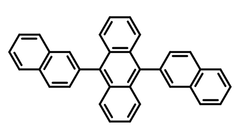
9,10-Bis(2-naphthyl)anthracene (ADN), which is well known for its high thermal and morphological stability, is widely used as the host material for blue OLEDs [1, 2].
However, with the development of the co-doping technology*, 9,10-Bis(2-naphthyl)anthrace has also shown to be a promising host material for full colour OLEDs due to its wide energy band gap [3, 4, 5].
*The co-doping system is a novel technique for colour tuning and increasing the emission characteristics of OLEDs, and the two-step energy transfer in this system plays a very important role in colour tuning and improvement of the device performance.General Information
| CAS number | 122648-99-1 |
| Chemical formula | C34H22 |
| Molecular weight | 430.54 g/mol |
| Absorption | λmax 375,395 nm (in THF) |
| Fluorescence | λem 425 nm (in THF) |
| HOMO/LUMO | HOMO = 5.8 eV, LUMO = 2.6 eV |
| Synonyms | ADN9,10-di(naphth-2-yl)anthracene9,10-di(2-naphthyl)anthracene |
| Classification / Family | Electron transporting materials, Light emitter layer materials, Fluorescent host materials; Light-emitting diodes, Organic electronics |
Product Details
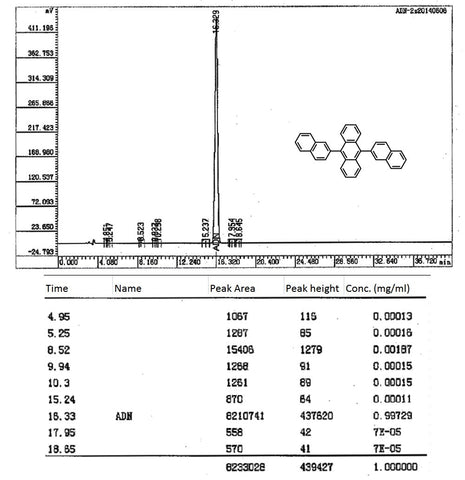
| Purity | >99.0% (sublimed) >98.0% (unsublimed) |
| Melting point | 382-384 °C (lit.) |
| Appearance | White powder |
*Sublimation is a technique used to obtain ultra pure-grade chemicals. For more details about sublimation, please refer to the Sublimed Materials for OLED devices page.
Chemical Structure
Device Structure(s)
| Device structure | ITO/NPB (60 nm)/BNA:2 wt% perylene (35 nm)/Alq3(25 nm)/Mg:Ag (200 nm) [6] (BNA is 9,10-Bis(2-naphthyl)anthrace, ADN) |
| Colour | Blue  |
| Max. Luminance | 4,000 cd/m2 |
| Max. Current Efficiency | 1.2 cd/A |
| Device structure | ITO/NPB (60 nm)/BNA:2 wt% perylene and 0.5 wt% DCJTB* (35 nm)/Alq3 (25 nm)/Mg:Ag (200 nm) [6] (BNA is 9,10-Bis(2-naphthyl)anthrace, ADN) |
| Colour | White  |
| Max. Luminance | 4,100 cd/m2 |
| Max. Current Efficiency | 1.65 cd/A |
| Device structure | ITO (100 nm)/ NPB (40 nm)/ADN:C6:DCJTB (30 nm)/Alq3(30 nm)/LiF (1 nm)/Al (100 nm) [3] |
| Colour | Red  |
| Max. Luminance | 13, 000 cd/m2 |
| Max. Current Efficiency | 4.9 cd/A |
| Device structure | ITO/NPB (70 nm)/ADN: 0.5% Rubrene (30 nm)/Alq3 (50 nm)/MgAg [7] |
| Colour | White  |
| Max. Luminance | 11,700 cd/m2 |
| Max. Current Efficiency | 3.7 cd/A |
| Max. Power Efficiency | 1.72 lm W-1 |
| Device structure | ITO (80 nm)/m-MTDATA (20 nm)/NPB (20 nm)/[ADN:Alq3 (4:1)]:1wt.% DCJTB:0.2wt.%C545T/Alq3 (30 nm)/LiF (1 nm)/Al (100 nm) [8] |
| Colour | Red  |
| Max. Luminance | 11,600 cd/m2 |
| Max. Current Efficiency | 3.6 cd/A |
| Device structure | ITO/ NPB (70 nm)/DPVBi:BCzVBi (15 wt%, 15 nm)/ADN:BCzVBi (15% wt%, 15 nm)/BPhen (30 nm)/ Liq (2 nm)/Al (100 nm) [9] |
| Colour | Deep Blue  |
| Max. Luminance | 8,668 cd/m2 |
| Max. Current Efficiency | 5.16 cd/A |
*For chemical structure informations please refer to the cited references
Characterisation
Pricing
| Grade | Order Code | Quantity | Price |
| Sublimed (>99.0%) | M461 | 1 g | £215.00 |
| Sublimed (>99.0%) | M461 | 5 g | £754.00 |
| Unsublimed (>98.0%) | M462 | 5 g | £282.00 |
MSDS Documentation
 ADN MSDS sheet
Literature and Reviews
- Anthracene derivatives for stable blue-emitting organic electroluminescence devices, J. Shi et al., Appl. Phys. Lett. 80, 3201 (2002); http://dx.doi.org/10.1063/1.1475361.
- Study of the Hole and Electron Transport in Amorphous 9,10-Di-(2′-naphthyl)anthracene: The First-Principles Approach, H. Li et al., J. Phys. Chem. C, 117 (32), 16336–16342 (2013), DOI: 10.1021/jp4050868
- Highly Efficient and Stable Red Organic Light-Emitting Devices Using 9,10-Di(2-naphthyl)anthracene as the Host Material, H. Tang et al., Jpn. J. Appl. Phys. 46 1722 (2007), http://iopscience.iop.org/1347-4065/46/4R/1722.
- Green organic light-emitting diodes with improved stability and efficiency utilizing a wide band gap material as the host, H. Tang et al., Displays, 29 (5), 502-505 (2008), doi:10.1016/j.displa.2008.05.001.
- Improved efficiency for green and red emitting electroluminescent devices using the same cohost composed of 9,10-di(2-naphthyl) anthracene and tris-(8-hydroxyquinolinato) aluminum, J. Zhu et al., Physica E, 42 (2), 158-161 (2009), doi:10.1016/j.physe.2009.09.020.
- Blue and white organic electroluminescent devices based on 9,10-bis(2′-naphthyl)anthracene, X. H. Zhang et al., Chem. Phys. Lett., 369 (3-4) 478-482 (2003), doi:10.1016/S0009-2614(02)02042-0.
- Efficient and stable single-dopant white OLEDs based on 9,10-bis (2-naphthyl) anthracene, S. Tao et al., J. Luminance, 121(2), 568-572 (2006); doi:10.1016/j.jlumin.2005.12.053.
- Red organic light-emitting diodes with high efficiency, low driving voltage and saturated red color realized via two step energy transfer based on ADN and Alq3 co-host system, K. Haq et al., Curr. Appl. Phys., 9, 257-262 (2009); doi:10.1016/j.cap.2008.02.005.
- Highly efficient blue organic light-emitting diodes using dual emissive layers with host-dopant system, B. Lee et al., J. Photon. Energy. 3(1), 033598 (2013), doi:10.1117/1.JPE.3.033598.
To the best of our knowledge the technical information provided here is accurate. However, Ossila assume no liability for the accuracy of this information. The values provided here are typical at the time of manufacture and may vary over time and from batch to batch.
ebiomall.com






>
>
>
>
>
>
>
>
>
>
>
>
就是蛋白质分子的小片断
是氨基酸形成的
求助各位前辈,我最近在合成的化合物水溶性很好,非常好,以至于可以随便溶解在水里,它的六氟磷酸盐也可以随意溶解在水里(大于50uM),细胞成像实验显示它根本进不去细胞,求问有没有啥方法包裹一下让它进去?我搜了一下文献,感觉多数是把脂溶性特别好的东西包裹一下弄进去的,也许是搜索姿势不对没找到我需要的答案,**点拨啊!!!
如题,之前没做过药代,老师给了一个600+Da的五肽,想测下药代动参数,看文献推荐上述两种方法,但是不知道选哪种更好,lcms前处理会不会影响小肽。
有机的是有机化合物的简称,它指的是含碳化合物.
但是,有四大类常见物质一般不作为有机物处理:
1、碳的氧化物,如CO和CO2.
2、碳酸及其盐,如CaCO3.
3、金属碳化物,如CaC2.
4、拟卤素及其化合物,如(CN)2与KSCN.
水的化学式为H2O,它不含有碳元素,故不是有机物.
但若所描述的水不是化学意义的水,而是自然界存在的天然水,那么,水中会溶有一定量的有机物.